

 Send Email
Best Hex Bolts: How to Choose the Right Grade for Your Project?
Correct hex bolt grade ensures project safety, longevity, and structural integrity, preventing premature failure. Industry veteran Guy Avellon states incorrect fastener selection causes 5% of hex bolt failures. Understanding application demands, material properties, and environmental factors determines the Best Hex Bolts. Proper knowledge of hex bolt grades, like hex bolts grade 8 vs grade 10.9, helps decide which bolt grade is best.
Key Takeaways
- Choose the right hex bolt grade for project safety. Consider load types, environment, and material compatibility.
- Understand hex bolt grading systems. Metric grades (like 8.8) and imperial grades (like Grade 5) show bolt strength.
- Select appropriate materials and coatings. Carbon steel, stainless steel, and alloy steel offer different benefits. Coatings protect against rust.
Understanding Project Demands for Hex Bolts
Assessing Load Types and Stress
Engineers must first understand the forces acting on a fastener. Projects involve various load types. Tensile loads pull the bolt apart. Shear loads try to cut the bolt. Dynamic loads, like vibrations or impacts, create fluctuating stress. Each load type requires a specific bolt strength. Selecting the correct grade ensures the bolt withstands these forces without failure.
Evaluating Environmental Conditions
The environment significantly impacts hex bolt performance. Corrosion is a major concern, even in mild conditions. Prolonged exposure to humid conditions causes extensive white corrosion. High temperatures reduce a bolt's yield strength, leading to permanent deformation. Creep, a slow deformation under constant load, also increases with heat. Conversely, low temperatures make metal brittle, reducing its ability to deform plastically. Cold also affects pre-load by causing metal contraction.
Environmental Factors Affecting Hex Bolts:
- Temperature extremes
- Humidity
- UV radiation
- Chemical exposure
- Vibrations
Considering Material Compatibility
Material compatibility is crucial to prevent galvanic corrosion. This occurs when two electrochemically dissimilar metals touch in the presence of an electrolyte, like water. The less noble metal corrodes at an accelerated rate. For example, using stainless steel bolts on bare carbon steel in a marine atmosphere causes rapid carbon steel degradation. Carbon steel hex bolts fixed into aluminum structures without insulation also pose a risk. To prevent this, use metals with similar electrochemical properties. Insulating dissimilar metals or preventing moisture exposure also minimizes corrosion.
Decoding Hex Bolts Grades and Materials
Understanding the grading systems for hex bolts is essential. These systems classify bolts based on their strength and material properties. Both metric and imperial systems exist, each with its own set of standards.
Metric Hex Bolt Grading System
The metric grading system uses a numerical code, such as 8.8, 10.9, or 12.9. This code provides direct information about the bolt's mechanical properties. The first number indicates the ultimate tensile strength in megapascals (MPa) when multiplied by 100. For example, an 8.8 grade bolt has a nominal tensile strength of 800 MPa. The second number, when multiplied by 10, gives the ratio of the yield strength to the ultimate tensile strength. So, an 8.8 grade bolt has a yield strength that is 80% of its tensile strength (0.8 x 800 MPa = 640 MPa). Higher numbers indicate stronger bolts.
Engineers often choose specific metric grades based on their material composition and heat treatment. This table shows common metric grades:
| Class | Material Composition | Heat Treatment |
|---|---|---|
| 8.8 | Medium carbon steel | Quenched and tempered |
| 10.9 | Alloy steel | Quenched and tempered |
| 12.9 | Alloy steel | Quenched and tempered |
Another table provides more detail on the heat treatment for these classes:
| Class | Notes on Heat Treatment |
|---|---|
| 8.8 | Non-heat-treated; low structural performance |
| 10.9 | Quenched & tempered; medium strength |
| 12.9 | Quenched & tempered; medium strength |
Imperial Hex Bolt Grading System
The imperial grading system uses a series of grades, most commonly Grade 2, Grade 5, and Grade 8. Manufacturers identify these grades by specific markings on the bolt head. Grade 2 bolts have no markings. Grade 5 bolts feature three radial lines. Grade 8 bolts show six radial lines. Each grade represents a different level of tensile strength. Grade 8 bolts offer the highest strength among these common imperial grades. They are suitable for heavy-duty applications.
Common Hex Bolt Material Types
Hex bolts are essential fasteners across various sectors. These include construction, automotive, marine, and aerospace. They offer crucial performance benefits such as strength, durability, and corrosion resistance. Selecting the appropriate hex bolt material is vital for ensuring superior performance and long-term reliability in both industrial and home applications.
Different materials provide distinct advantages for specific uses:
-
Carbon Steel: This is the most common and cost-effective material. It offers good strength for general-purpose applications. However, it requires coatings for corrosion resistance.
-
Stainless Steel: Stainless steel bolts provide excellent corrosion resistance. This makes them ideal for outdoor or marine environments. Two common types are 304 and 316 stainless steel.
Grade Typical Applications Performance Characteristics 304 Stainless Steel General construction, structural connections (non-coastal), general industrial use Excellent corrosion resistance in most environments, good strength, best value for general use 316 Stainless Steel Marine applications (dock construction, boat building, marine equipment), coastal construction, industrial settings with chemical exposure, saltwater environments Superior resistance to pitting corrosion, especially in chloride environments (saltwater, chemicals), contains molybdenum for enhanced resistance -
Alloy Steel: Manufacturers combine carbon steel with other elements to create alloy steel. This process improves strength and toughness. Alloy steel bolts often undergo heat treatment to enhance their mechanical properties.
-
Performance Characteristics (8.8 Grade Hex Bolts):
- Tensile Strength: Nominal tensile strength reaches 800MPa.
- Yield Strength: Nominal yield strength is 640MPa.
- Corrosion Resistance: The surface is typically oxidized to improve corrosion resistance and prevent rusting.
- Material: Primarily low carbon alloy steel or medium carbon steel, heat-treated (quenching and tempering) to enhance strength and hardness.
- Classification: Considered high-strength bolts, suitable for larger loads.
-
Application Scenarios (8.8 Grade Hex Bolts):
- Steel Structure Engineering: Used to connect thick steel plate nodes in steel structures for stability and safety.
- Bridges, Buildings, Mechanical Equipment: Indispensable fasteners in these fields.
- Harsh Environments: Suitable for marine engineering and chemical equipment due to high strength and corrosion resistance.
Alloy steel bolts also offer these general benefits:
- Improved Strength and Toughness: Achieved by combining carbon steel with other elements.
- Resistance to Environmental Factors: Designed to withstand harsh conditions.
- Higher Load Capacity: Can withstand greater loads compared to standard steel bolts.
- Enhanced Mechanical Properties: Often heat-treated to improve integrity under stress.
- Tailored Composition: Alloy composition can be customized to meet specific standards (e.g., ASTM, ISO).
-
Performance Characteristics (8.8 Grade Hex Bolts):
Selecting the Right Hex Bolts for Performance
Coatings and Finishes for Hex Bolts
Coatings significantly enhance hex bolt performance. Zinc plating offers protection against rust. It suits indoor furniture assembly, light machinery, and electrical installations. However, zinc plating may not perform well in very wet or high-humidity environments. It is also susceptible to acids and alkalis. Hot-dip galvanization provides a much thicker layer of corrosion resistance. This process makes hex bolts highly useful for outdoor structures. These include bridges, marine applications, and construction projects. A hot-dip galvanized fastener can resist corrosion for approximately 30 years in coastal regions. This is a significant improvement over standard zinc-plated products.
Size and Thread Type for Hex Bolts
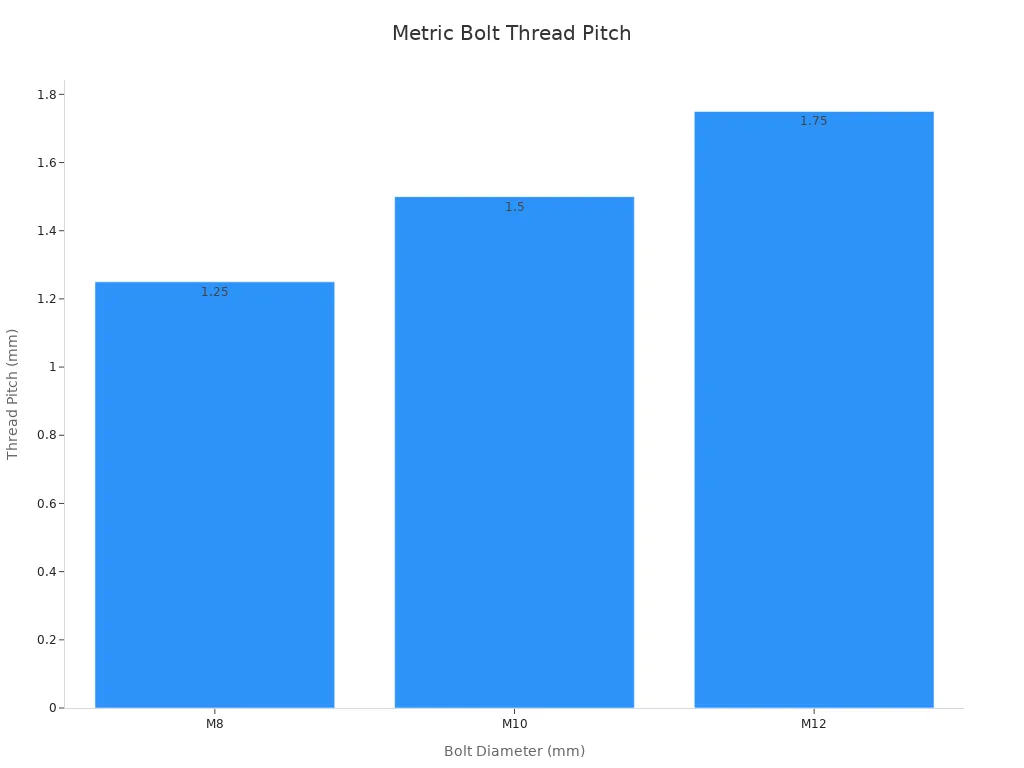
Choosing the correct size and thread type ensures a secure connection. Bolt diameter and thread pitch must match the application. Metric hex bolts follow specific standards for thread pitch. For example, an M8 bolt has a standard thread pitch of 1.25 mm. An M10 bolt uses a 1.5 mm pitch. An M12 bolt requires a 1.75 mm pitch. This table shows common metric thread pitches:
| Bolt Diameter (mm) | Standard Thread Pitch (mm) |
|---|---|
| 8 | 1.25 |
| 10 | 1.5 |
| 12 | 1.75 |
Ensuring Fastener Compatibility
Ensuring fastener compatibility prevents serious issues. Incompatible materials or grades lead to premature failure. Bolts may stretch or fracture, causing structural collapse. Fatigue failure also occurs with lower tensile strength fasteners. This leads to micro-cracks and sudden failure. Catastrophic accidents can result in critical applications. Unexpected fastener failure damages expensive components. This increases repair costs and downtime. Using high-strength fasteners in low-load scenarios also creates problems. It can damage delicate materials. It also increases installation complexity and costs.
Matching the correct hex bolt grade to project requirements is crucial for success. Engineers must consider load types, environmental conditions, material properties, and compatibility during selection. Adhering to industry standards ensures safety and reliability for all Hex Bolts, preventing failures and guaranteeing long-term performance.
FAQ
What do the numbers in metric hex bolt grades signify?
Metric hex bolt grades, like 8.8, show strength. The first number indicates tensile strength. The second number represents the yield strength ratio. Higher numbers mean stronger bolts.
Why is material compatibility important for hex bolts?
Material compatibility prevents galvanic corrosion. This occurs when dissimilar metals touch, causing one to corrode faster. Matching materials or insulating them avoids this issue.
How do coatings improve hex bolt performance?
Coatings like zinc plating or hot-dip galvanization protect hex bolts from corrosion. They extend the bolt's lifespan, especially in harsh or outdoor environments.
