

 Send Email


For bulk fastener buyers, the lowest quoted unit price rarely tells the full story. Packaging decisions influence freight density, receiving labor, inventory accuracy, product protection, and even production uptime. A carton that is too weak, a crate that is difficult to handle, or a bulk bin without verified counts can quickly turn a low-cost shipment into an operational headache. This article examines practical packaging choices for high-volume hex bolt procurement, including master cartons, inner boxes, bulk kegs, labeling, palletization, and damage prevention. By treating packaging as a cost-control and supply-chain performance variable, buyers can reduce hidden expenses and keep fasteners moving efficiently from supplier to point of use.
Why Packaging Matters for Bulk Hex Bolt Buyers
When procuring industrial fasteners at scale, procurement teams often focus intensely on unit price, material grade, and production lead times, treating packaging as a secondary afterthought. However, for bulk buyers of hex bolts, packaging is a critical variable that directly influences the total cost of ownership, supply chain velocity, and product integrity. While the packaging materials themselves typically account for just 3% to 8% of the total unit cost, inefficient or substandard packaging can inflate downstream operational expenses significantly.
A holistic approach to packaging evaluates the journey of the fastener from the manufacturer's floor to the end-user's assembly line. Whether the bolts are destined for a heavy construction site, a high-volume automotive plant, or a retail distribution center, the chosen packaging format dictates how easily the inventory can be transported, stored, and consumed. Failing to specify packaging requirements during the procurement phase often leads to hidden costs, including increased labor for repacking, higher freight charges due to poor spatial efficiency, and compromised product quality from transit damage.
Total Landed Cost and Handling Impact
The total landed cost of a fastener shipment extends far beyond the ex-works price and basic freight charges. Packaging directly impacts volumetric weight, container utilization, and the labor required for unloading and staging. For instance, receiving bulk shipments in non-standardized wooden crates may require manual sorting and repacking before the inventory can be integrated into a warehouse management system. This manual intervention can add an estimated $0.05 to $0.12 per piece in domestic labor costs, rapidly eroding the savings gained from aggressive unit price negotiations.
Furthermore, inadequate packaging increases the risk of transit damage. Fasteners are inherently heavy and dense; if master cartons lack the necessary burst strength, they can rupture under the dynamic loads experienced during sea or rail transport. A rupture rate of even 2% in a high-volume shipment can lead to significant material loss, production downtime, and the administrative burden of processing insurance claims and replacement orders. Selecting robust, optimized packaging mitigates these risks, ensuring that the total landed cost remains predictable and controlled.
Inventory Accuracy and Replenishment
Inventory accuracy relies heavily on how products are grouped, labeled, and stored. When hex bolts arrive in standardized master cartons with exact, verified piece counts—such as precisely 500 pieces per carton or 50 pieces per inner box—warehouse personnel can perform cycle counts and receiving audits with maximum efficiency. Conversely, receiving fasteners in large, uncalibrated bulk bins often forces facilities to rely on weight-based counting scales, which can introduce a 3% to 5% variance in inventory accuracy due to minor fluctuations in individual bolt weights and tare weights.
Efficient replenishment also depends on the packaging format matching the consumption rate of the assembly line or job site. If a manufacturing cell consumes 200 bolts per shift, supplying the line with 25-kilogram bulk kegs creates unnecessary clutter, increases the risk of mixed batches, and complicates the return of unused stock to the warehouse. By aligning the packaging piece count with the replenishment cycle, organizations can implement leaner inventory practices, reduce floor space requirements, and maintain tighter control over lot traceability.
Key Packaging Terms to Define
To effectively negotiate and specify packaging requirements with fastener manufacturers, procurement professionals must be fluent in industry-standard packaging terminology. Miscommunications regarding weight limits, carton types, or pallet configurations can lead to shipments that violate occupational safety regulations or fail to fit into automated storage and retrieval systems (ASRS). Clear definitions prevent costly rework at the port of entry or the receiving dock.
The following table outlines the foundational packaging terms and the standard thresholds typically applied in bulk fastener logistics:
| Packaging Term | Industry Definition | Standard Metric / Threshold |
|---|---|---|
| Master Carton | The primary outer corrugated box holding bulk loose bolts or multiple inner boxes. | Maximum gross weight of 20 to 25 kg (44 to 55 lbs) for ergonomic compliance. |
| Inner Box | A smaller unit box packaged inside the master carton, used for kitting or retail. | Typically holds 1 to 5 kg (2.2 to 11 lbs) or specific piece counts (e.g., 100 pcs). |
| Tare Weight | The total weight of the empty packaging materials (pallets, cartons, bags, strapping). | Averages 1.5 to 3 kg per master carton setup; pallets add 15 to 25 kg. |
| VCI Poly Bag | A polyethylene bag treated with Volatile Corrosion Inhibitors to prevent rust. | Standard thickness ranges from 4 to 6 mil for heavy industrial fasteners. |
Bulk Hex Bolt Packaging Formats to Compare
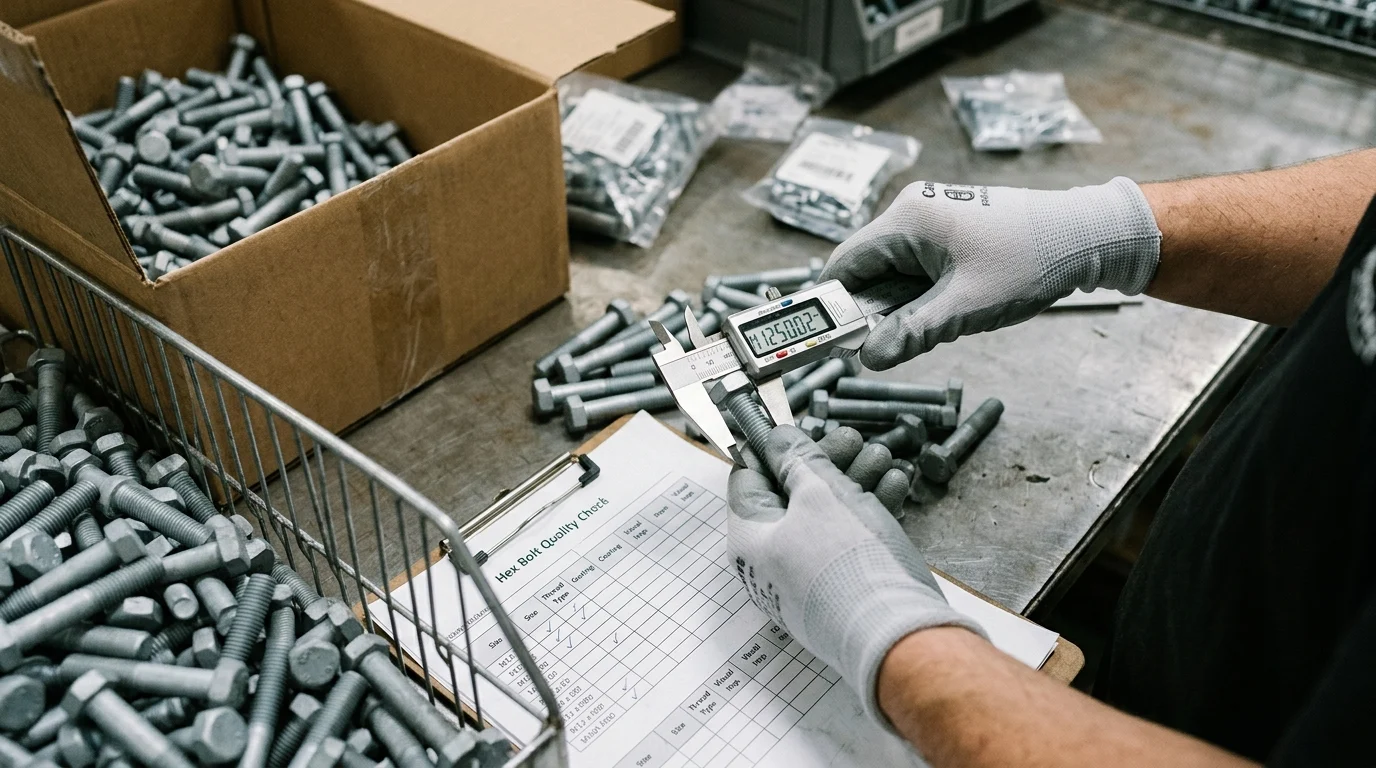
The fastener industry utilizes several standardized packaging formats to accommodate the immense weight and density of steel hardware. For bulk buyers, selecting the appropriate format requires balancing upfront material costs against the logistical demands of the end-user. While heavy-duty corrugated cardboard remains the global standard for international shipping, alternative formats like plastic pails and returnable metal bins offer distinct advantages for specific domestic supply chains.
Understanding the structural hierarchy and material composition of these formats is essential. A single metric ton of hex bolts represents a concentrated, shifting load that can easily destroy standard consumer-grade packaging. Therefore, bulk fastener packaging must be engineered for burst strength, stacking integrity, and puncture resistance.
Cartons, Inner Boxes, and Poly Bags
The most prevalent packaging format for imported fasteners is the combination of master cartons, inner boxes, and protective poly bags. Master cartons used for heavy hardware are typically constructed from double-wall or triple-wall corrugated fiberboard, boasting an edge crush test (ECT) rating of at least 48 to 51 lbs/in. These cartons are designed to hold a maximum of 25 kilograms (approximately 55 pounds), which aligns with international manual handling limits. Inside the master carton, bolts are often sealed in polyethylene bags to prevent moisture ingress and contain any protective oil coatings applied at the factory.
Inner boxes are introduced when the bolts are destined for resale, distribution, or highly organized assembly environments. Instead of a single 25-kilogram bag, the master carton might contain ten smaller boxes weighing 2.5 kilograms each. While this multi-tiered approach adds roughly 10% to 15% to the initial packaging cost, it drastically reduces the time required for downstream sorting. The poly bags used within these cartons must also meet industrial specifications; a minimum thickness of 4 to 6 mil is required to prevent the sharp threads of the bolts from puncturing the plastic during transit.
Buckets, Bins, and Returnable Containers
For domestic distribution, particularly in the construction, agricultural, and heavy equipment sectors, buckets and bins are highly favored. High-density polyethylene (HDPE) plastic pails—usually in 3.5-gallon to 5-gallon capacities—offer superior weather resistance compared to corrugated cardboard. A standard 5-gallon pail can securely hold up to 30 kilograms of fasteners and features a reinforced handle for easy carrying across rugged jobsites. The rigid structure of buckets also prevents the crushing damage that can occur when heavy cartons are stacked unevenly.
In closed-loop supply chains, such as automotive manufacturing, returnable containers and stackable metal or rigid plastic bins (often referred to as totes or dunnage) are increasingly common. These containers are designed for automated handling and can be integrated directly into gravity-fed assembly line racks. While the initial capital expenditure for returnable bins is high, they can reduce packaging waste by up to 80% over a 5-year lifecycle. Buyers utilizing returnable containers typically engage in vendor-managed inventory (VMI) programs, where empty bins are continuously cycled back to the regional distributor for replenishment.
Standard Packs vs Custom Packs
The choice between standard bulk packs and custom kitted packs fundamentally alters the procurement timeline and cost structure. Standard packs—often referred to as "1/4 keg" boxes containing approximately 25 kilograms of loose bolts—are the most cost-effective option. Because fastener manufacturers produce these cartons at massive scale, utilizing standard packs ensures the shortest possible lead times and avoids specialized tooling or setup fees on the packaging line.
Custom packs, on the other hand, involve specific piece counts (e.g., exactly 144 pieces per box), specialized branding, blister packs, or kitting (where a bolt, nut, and two washers are pre-packaged together). Custom packaging requires additional manual labor or specialized automated counting machinery at the factory. Consequently, manufacturers typically impose higher Minimum Order Quantities (MOQs)—often exceeding 5,000 to 10,000 custom boxes—and may extend lead times by 2 to 4 weeks. Buyers must calculate whether the premium paid for custom packing at the source outweighs the domestic labor costs of kitting the hardware in-house.
Packaging Specifications and Compliance Requirements
Procuring structural and industrial fasteners requires stringent adherence to international engineering standards, and the packaging must reflect and protect those specifications. The physical characteristics of the bolts—ranging from their dimensional footprint to their chemical surface treatments—dictate the type of barrier protection required. A high-tensile bolt intended for aerospace applications demands a vastly different packaging environment than a standard low-carbon steel bolt used in general construction.
Furthermore, modern supply chains are heavily regulated. Packaging must comply with international phytosanitary standards for wooden materials, environmental regulations regarding plastic waste, and rigorous lot traceability requirements mandated by safety-critical industries. Failure to meet these compliance thresholds can result in shipments being quarantined at customs, leading to catastrophic project delays.
Bolt Size, Grade, Finish, and Coating
The physical dimensions and weight of the bolts directly influence pack density and carton structural requirements. Large-diameter fasteners, such as 1-1/2 inch structural hex bolts, leave significant void spaces when packed randomly in a carton. These voids can cause the carton to collapse when stacked on a pallet. To counteract this, large bolts must be meticulously hand-packed or layered with corrugated dividers, which increases labor costs but ensures structural integrity. Conversely, smaller bolts (e.g., 1/4 inch or M6) settle densely, meaning a much smaller carton will quickly reach the 25-kilogram weight limit.
Surface finishes and coatings also dictate packaging specifications. Plain finish or lightly oiled bolts require robust rust prevention, while hot-dip galvanized (HDG) bolts feature a rough, textured zinc coating that acts like sandpaper against packaging materials. HDG bolts require heavy-duty, puncture-resistant 6 mil poly bags or woven polypropylene sacks to prevent the bolts from shredding the inner lining during transit. For bolts with specialized friction coatings (like PTFE or Geomet), individual compartmentalized trays or foam netting may be necessary to prevent the bolts from chipping each other's finish during vibration.
Labels, Barcodes, and Lot Traceability
In industries such as automotive, aerospace, and structural steelwork, lot traceability is a non-negotiable compliance requirement. If a fastener fails in the field, the manufacturer and the buyer must be able to trace that specific bolt back to its original steel heat batch and production run. Packaging serves as the primary vehicle for this data. Master carton labels must clearly display the purchase order number, DIN/ISO standard, material grade, surface treatment, exact quantity, and a unique alphanumeric batch or lot number.
To facilitate rapid intake and automated inventory management, these labels must incorporate standardized barcodes or 2D matrix codes. Code 128 and QR codes are the industry standards, allowing warehouse scanners to instantly populate enterprise resource planning (ERP) systems with the carton's entire metadata profile. Labels should be printed on thermal transfer stock with high-durability resin ribbons to ensure they remain legible after weeks of exposure to humidity, UV light, and the friction of ocean transit.
Export Packing and Moisture Protection
When bulk fasteners are shipped internationally via sea freight, they are subjected to extreme environmental stressors. Temperature fluctuations inside a shipping container can cause "container rain," where condensation drips onto the cargo. To protect steel bolts from flash rusting, export packaging must incorporate active moisture protection. This is typically achieved by lining the master cartons with Volatile Corrosion Inhibitor (VCI) paper or bags, which release protective vapors that form a molecular barrier on the metal surface. Additionally, placing 50-gram to 100-gram silica gel desiccant packets inside each carton absorbs residual ambient moisture.
Compliance with the International Standards for Phytosanitary Measures No. 15 (ISPM-15) is mandatory for all wooden packaging materials, including pallets and crating. To prevent the global spread of timber pests, all wood must be heat-treated to a core temperature of 56°C for at least 30 minutes and stamped with the recognized IPPC mark. Furthermore, reputable fastener suppliers will ensure the moisture content of the wood is dried to below 20% prior to loading. Using uncertified or "green" wood pallets not only risks customs rejection but also introduces massive amounts of moisture into the shipping container, accelerating fastener corrosion.
Logistics, Storage, and Jobsite Use
The physical transition of bulk fasteners from a shipping container to a warehouse rack, and ultimately to the point of use, requires careful logistical planning. The sheer density of steel hardware means that spatial volume is rarely the limiting factor in transport; rather, weight capacities dictate how cargo is consolidated. Optimizing the packaging configuration at the pallet level is crucial for maximizing freight efficiency and minimizing handling risks.
Once the inventory reaches its destination, the packaging must integrate seamlessly with the facility's storage infrastructure and the daily workflows of the personnel. Packaging that is optimized for ocean freight is not always optimized for a fast-paced assembly line, necessitating a strategic balance between high-density transport and ergonomic, accessible jobsite usage.
Pack Density and Pallet Configuration
Maximizing container payload requires precise pallet configuration. A standard 20-foot shipping container has a maximum payload capacity of approximately 28,000 kilograms (61,700 lbs). Because fasteners are incredibly dense, a container will "weigh out" (hit its maximum weight limit) long before it "cubes out" (fills the available physical space). Therefore, pallets must be engineered to hold the maximum safe weight while maintaining a low center of gravity. A typical configuration for bulk hex bolts involves 36 master cartons per pallet (arranged in 4 layers of 9 cartons), yielding a net weight of roughly 900 kilograms per pallet.
Standardization of the pallet footprint is equally important. The EUR-pallet (1200 x 800 mm) and the North American standard pallet (48 x 40 inches) are the most common formats. To prevent load shifting during transit, the cartons must be stacked in an interlocking pattern, secured with high-tensile PET (polyester) or steel strapping with a break strength exceeding 600 lbs. The entire pallet load should then be wrapped in a minimum of 80-gauge stretch film, binding the cartons tightly to the wooden base and providing a final layer of dust and moisture protection.
Warehouse, Vending, and Assembly Line Needs
The storage environment heavily influences the ideal packaging format. In high-density automated warehouses, uniformity is paramount; cartons must feature consistent dimensions and flat tops to allow for robotic picking and conveyor transport. If the facility utilizes industrial vending machines for point-of-use inventory control, the fasteners must be pre-packaged in specific inner box dimensions or coiled formats that fit the vending machine's dispensing coils, eliminating the need for staff to manually count and load loose bolts.
On manufacturing assembly lines, speed and accessibility are the primary concerns. Operators cannot afford to spend time slicing open taped cartons and tearing through thick poly bags. In these environments, hopper-ready packaging is preferred. This might involve cartons with perforated tear-away fronts (shelf-ready packaging) or the use of standardized plastic totes that slide directly into gravity-flow racks. By designing the packaging to support the assembly workflow, companies can shave seconds off every production cycle, resulting in significant cumulative labor savings.
Weight Limits, Safety, and Damage Prevention
Safety and ergonomic compliance are critical considerations when handling bulk fasteners. International labor guidelines and organizations like OSHA generally recommend a maximum manual lifting limit of 23 kilograms (50 pounds) for a single worker under ideal conditions. Consequently, fastener master cartons should never exceed this threshold unless they are explicitly designated for forklift or mechanical hoist handling only. Overweight cartons not only invite worker compensation claims due to musculoskeletal injuries but also increase the likelihood of the carton being dropped and destroyed.
Damage prevention during jobsite use requires packaging that can withstand harsh, uncontrolled environments. A cardboard carton left on a wet concrete floor at a construction site will quickly wick moisture, compromising its structural integrity and causing the bottom to fall out when lifted. For outdoor or rugged applications, transitioning to weather-resistant plastic pails, or specifying wax-coated corrugated boxes, provides the necessary durability. Additionally, clearly printing weight warnings and handling symbols (e.g., "Keep Dry," "Do Not Stack Over 4 High") on all outer packaging helps ensure that third-party logistics providers and jobsite contractors handle the materials safely.
How to Select the Best Packaging Option
Selecting the optimal packaging option for bulk hex bolts is not a one-size-fits-all endeavor; it is a strategic procurement decision that requires cross-functional input from logistics, warehousing, safety, and assembly teams. The objective is to engineer a packaging solution that minimizes total landed cost while maximizing operational efficiency and product protection.
To achieve this, procurement professionals must move away from accepting default factory packaging and instead proactively dictate packaging specifications during the sourcing process. By utilizing structured decision matrices, enforcing rigorous RFQ requirements, and conducting periodic audits, buyers can transform fastener packaging from a logistical liability into a streamlined asset.
Decision Matrix: Cost, Risk, and Labor
A robust decision matrix helps teams objectively evaluate the trade-offs between different packaging formats. The matrix should weigh upfront material costs against the hidden costs of risk (transit damage, corrosion) and labor (unpacking, sorting, inventory counting). For example, while bulk cartons offer the lowest initial price, they score poorly on unpacking labor if the end-user requires small, kitted quantities.
The following matrix illustrates a comparative evaluation of common packaging strategies for bulk buyers:
| Packaging Format | Upfront Cost Premium | Transit Protection Level | Unpacking / Handling Labor | Best Suited For |
|---|---|---|---|---|
| Standard Bulk Cartons (25kg) | Baseline ($) | Moderate (Requires VCI & good palletizing) | High (Requires manual sorting/weighing) | High-volume manufacturing, heavy construction |
| Master Cartons with Inner Boxes | +10% to 15% ($$) | High (Double layer of corrugated board) |
Key Takeaways
- Specify packaging requirements during procurement because packaging can represent only 3% to 8% of unit cost but strongly affects total landed cost.
- Use standardized cartons and inner boxes with verified counts to improve receiving audits, cycle counts, and warehouse replenishment.
- Avoid non-standard crates when possible because manual sorting and repacking can add an estimated $0.05 to $0.12 per piece in labor costs.
- Select cartons with sufficient burst strength for dense fasteners to reduce rupture risk during sea, rail, or truck transport.
- Match packaging size to actual consumption rates, such as avoiding 25-kilogram kegs when a production cell uses only 200 bolts per shift.
- Do not rely solely on weight-based counting for bulk bins, as bolt and tare-weight variation can create 3% to 5% inventory variance.
Frequently Asked Questions
Why does packaging matter when buying hex bolts in bulk?
Packaging affects total landed cost, freight efficiency, warehouse handling, inventory accuracy, and damage risk. Even if packaging is only 3% to 8% of unit cost, poor choices can create larger downstream expenses.
What packaging format is best for warehouse receiving?
Standardized master cartons with verified piece counts, such as 500 pieces per carton or 50 pieces per inner box, make receiving audits, cycle counts, and replenishment faster and more accurate.
How can poor packaging increase fastener costs?
Non-standard crates, weak cartons, or uncounted bulk bins can add labor for sorting, repacking, and counting. Manual handling may add an estimated $0.05 to $0.12 per piece in domestic labor costs.
What are the risks of weak cartons for heavy hex bolts?
Hex bolts are dense and can rupture low-strength cartons during sea, rail, or truck transport. Even a 2% rupture rate can cause material loss, delays, claims, and replacement-order costs.
Should buyers choose bulk bins or smaller inner boxes?
The choice should match consumption. Bulk bins may suit high-volume job sites, while smaller inner boxes are better for assembly lines that need controlled quantities and lower risk of mixed batches.